

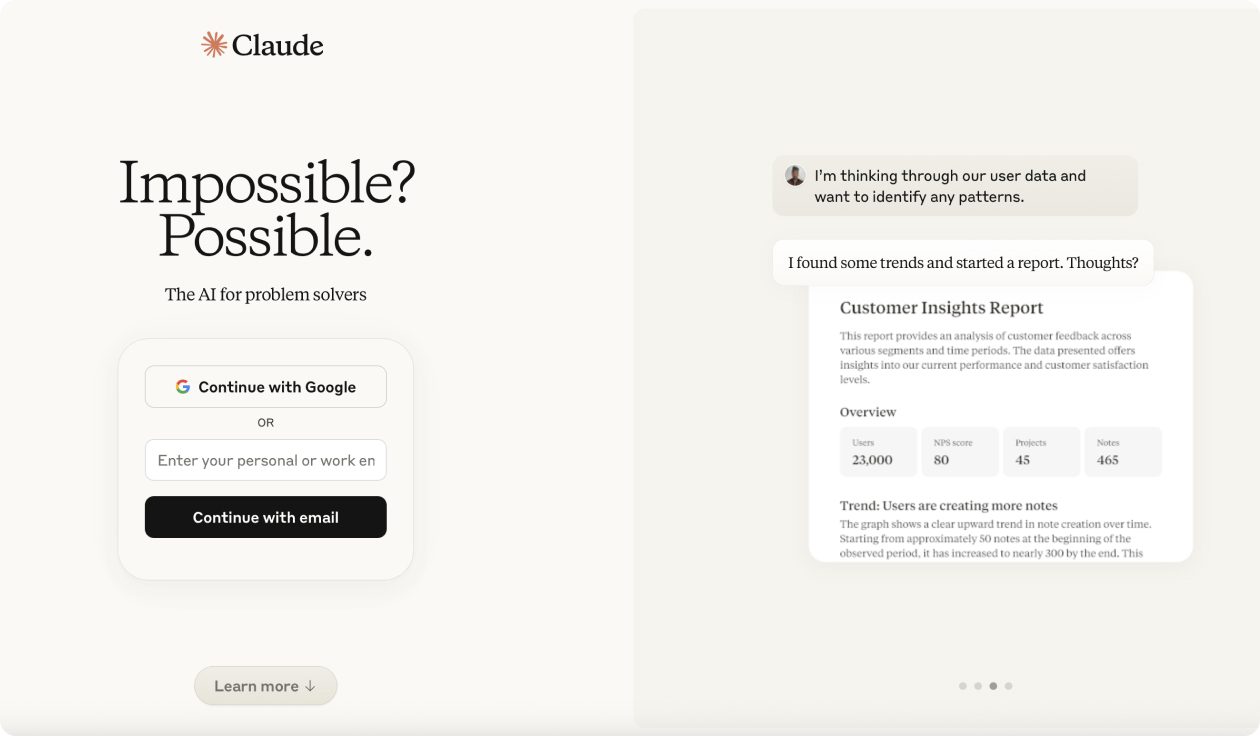
What is Claude AI for UX Research?
Claude AI is Anthropic’s advanced conversational AI assistant that transforms how UX designers and researchers approach user research. Unlike generic AI tools, Claude excels at nuanced research tasks like analyzing qualitative data, synthesizing user interviews, creating research frameworks, and translating complex insights into actionable design recommendations.
Built with deep reasoning capabilities and strong ethical guidelines, Claude helps UX professionals move from data overload to meaningful insights faster than ever. Whether you’re drowning in interview transcripts, struggling to find patterns in user feedback, or need to create compelling research deliverables for stakeholders, Claude acts as your intelligent research partner—understanding context, asking thoughtful questions, and helping you uncover the insights that drive better user experiences.
Key Features for Claude AI Research
- Qualitative Data Analysis: Upload interview transcripts, survey responses, or user feedback and get instant thematic analysis. Claude identifies patterns, extracts key quotes, and organizes findings into research themes you can act on.
- Research Framework Creation: Generate research plans, interview guides, survey questions, and usability testing scripts tailored to your specific research goals and user segments.
- Insight Synthesis & Summary: Transform hours of user research into concise, stakeholder-ready summaries. Claude distills complex findings into clear insights with supporting evidence and user quotes.
- Persona & Journey Map Development: Create detailed user personas and customer journey maps based on real research data. Claude helps identify pain points, motivations, and opportunities for design improvement.
- Content Analysis & Coding: Automatically code qualitative research data, identify sentiment patterns, and organize feedback into meaningful categories for deeper analysis.
- Research Presentation Support: Generate compelling research reports, executive summaries, and presentation content that communicates user insights in language stakeholders understand and act on.
- Hypothesis Generation: Explore research questions, generate testable hypotheses, and suggest research methodologies based on your research objectives and constraints.
- Competitive Analysis: Analyze competitor experiences, identify UX patterns, and synthesize competitive insights to inform design decisions.
- Research Repository Management: Organize and tag research findings for easy retrieval. Claude helps create searchable research databases and identifies connections across studies.
- Design Recommendation Translation: Convert research insights into specific, actionable design recommendations with priority levels and rationale for development teams.
Claude AI Pricing
- Free Plan
- Pro Plan: $20/month
- Team Plans: Starting at $25/user/month
Claude UX Research Use Cases
- User Interview Analysis: Upload interview transcripts and get instant thematic analysis, key quote extraction, and insight summaries. Perfect for processing multiple user interviews quickly and identifying patterns across participants.
- Survey Data Interpretation: Analyze open-ended survey responses, identify sentiment trends, and extract actionable insights from qualitative feedback at scale.
- Usability Test Report Generation: Transform usability testing observations into comprehensive reports with categorized findings, severity ratings, and specific design recommendations.
- Research Planning & Strategy: Get help designing research studies, creating participant screeners, writing interview questions, and selecting appropriate research methodologies for your objectives.
- Persona Development: Create data-driven user personas by analyzing research findings, identifying user segments, and documenting behavioral patterns, goals, and pain points.
- Customer Journey Mapping: Build detailed journey maps by synthesizing touchpoint data, identifying pain points and opportunities, and mapping emotional states throughout user experiences.
- Content Strategy Research: Analyze user language patterns, content preferences, and information architecture needs to inform content strategy and IA decisions.
- Accessibility Research Analysis: Evaluate accessibility research findings, identify barriers for different user groups, and generate inclusive design recommendations.
- Research Democratization: Help non-researchers in your organization understand and apply user insights by creating accessible summaries and actionable recommendations from complex research data.
- Competitive UX Analysis: Analyze competitor interfaces, identify UX patterns and best practices, and generate insights that inform your own design strategy.
Pros for Claude UX Research
- Massive time savings: Reduces research analysis time from days to hours
- Pattern recognition excellence: Identifies subtle themes human analysts might miss
- Consistent quality: Delivers reliable analysis quality regardless of researcher fatigue or bias
- Stakeholder communication: Translates research jargon into business language executives understand
- Research democratization: Enables non-researchers to extract value from user data
- Hypothesis generation: Suggests new research questions and directions based on findings
- Multi-format handling: Processes text, documents, and various data formats seamlessly
- Always available: 24/7 research support for global teams and tight deadlines
- Cost-effective scaling: Handle larger research volumes without hiring additional analysts
- Objective analysis: Reduces human bias in qualitative data interpretation
- Research methodology guidance: Provides expert-level research planning and execution advice
Cons for Claude UX Research
- Context limitations: May miss nuanced cultural or domain-specific insights that human researchers catch
- No direct user interaction: Cannot conduct interviews, observations, or hands-on user testing
- Data privacy concerns: Uploading sensitive user data requires careful consideration of privacy policies
- Over-reliance risk: Teams might skip critical thinking and rely too heavily on AI-generated insights
- Limited multimedia analysis: Cannot analyze video recordings, audio files, or visual user behavior directly
- Subscription costs: Pro features require ongoing monthly expenses for active researchers
- No real-time research: Cannot participate in live user sessions or adapt research methods dynamically
- Template-like outputs: AI-generated personas and reports may lack the human touch that makes research compelling
- Industry knowledge gaps: May not understand specific industry contexts or specialized user behaviors
- Quantitative limitations: Primarily focused on qualitative analysis, less helpful for statistical research